Who Is James Maxwell's Family Who Is James Maxwell's Family
[This essay, which the The James Clerk Maxwell Foundation site has kindly shared with readers of the Victorian Web, is based on a talk given at the conference
At the International Scientific discipline Festival in Edinburgh in 1991 there was a unique coming together when there came together two members of the present generation who are related to James Clerk Maxwell (JCM) and his lifelong friend and scientific colleague Peter Guthrie Tait, Professor of Natural Philosophy at the Academy of Edinburgh for over 40 years. Present were Sir John Clerk, 10th Baronet and neat grandson of Maxwell's uncle Sir George Clerk, and Mr Tait, a great grandson of Professor P.G Tait. It was probably over a hundred years since the Clerks and Taits had concluding met, a reminder of a unique era in Scottish intellectual life.
James Clerk Maxwell came from a remarkable line of progenitors. He seemed to exemplify the relationship of his towering intellect to genetic inheritance. The famous concert pianist John Lill, later on winning the Inter-national Tchaikovsky Piano Contest in Moscow, was asked where had he got his music from. He was somewhat perplexed past this question and unable to answer it since none of the previous generations of his family had been at all musical. If James Clerk Maxwell had been asked a similar question he would not accept had to look very far for an answer. On his father's side he was a member of the Clerk family, the Clerks of Penicuik, and on his mother's side a fellow member of the Cay family, the Cays of Northumberland.
The Clerk Family
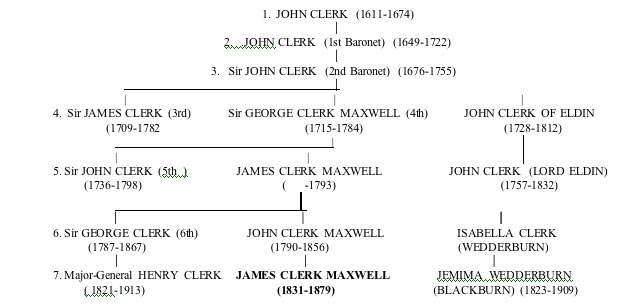
The name Maxwell was added to the family tree in the following way. William Clerk, a brother of Sir John Clerk (2nd Bart.) had married Agnes Maxwell and they had a girl Dorothea. Sir John'due south son George and so married his cousin Dorothea, inheriting the Maxwell estates provided he assumed the Maxwell name which he did equally 'Clerk Maxwell'. It was thus through his g-father, the son of George, and his male parent that James Clerk Maxwell inherited the Middlebie estate of Glenlair.
The Clerks of Penicuik were a remarkable family. For two hundred years they produced men of such conspicuous talent and originality in a wide range of fields that use of the discussion "genius" is not inappropriate: indeed Sir Walter Scott had spoken nearly "the heritable genius of the family." Through five generations the family unit occupied a central place in the cultural history and intellectual life of Scotland.
Sir John Clerk FRS, FSA (1676-1755)

Sir John Clerk of Penicuik (great great granddaddy of JCM)
Sir John Clerk (2nd Baronet), coming from the third generation of the Clerks, was the keen swell granddad of James Clerk. He was educated at Penicuik school where he learned Latin and Greek. He proceeded from there to the University of Glasgow or Glasgow College as it was called in those days. Of his choice of Glasgow he said "I love neither Aberdeen nor St Andrews, I abhor Edinburgh and therefore I have fixed upon Glasgow.
He had a zest for intellectual challenge for his teacher at the University of Glasgow said of him, "He of all my scholars gives the greatest satisfaction. I find him mightily ambitious to exist the first and all-time and he spares no pains to deserve and larn that pre-eminence."
In 1694 at the age of 18 his begetter sent him to the University of Leiden in Holland to study Constabulary. A period of report at Leiden in the late 17th century was a usual and necessary stage for a well-to-exercise Scotsman destined for the Bar and John Clerk was one of twelve Scotsmen who proceeded to Leiden that year.
Sir John — as he afterward would exist — would not allow his wide ranging talents to exist channelled into the report of constabulary alone and he studied painting, cartoon, music and mathematics. Indeed, in his early days at Leiden, mathematics had fired his intellect, and he said that "without mathematics he would initially have spent his time in idleness." His father disapproved, proverb, "the Italians call a fool a piddling mathematician and I hope you are not so great a fool as to aim at being a famous i." (The family would accept to wait for a few more generations for its most famous mathematical physicist).
At Leiden he became friendly with Hermann Boerhaave, later to become i of the greatest medical teachers of the eighteenth century and one of the greatest of all fourth dimension. Indeed such was Boerhaave'southward fame that a gentleman in Cathay desirous of writing to him addressed his letter, "Dr Boerhaave, Europe" — it had no difficulty in reaching its destination. Sir John was after to send two of his sons to written report medicine under Boerhaave. Among his other achievements Sir John Clerk was a talented musician and composer and, interestingly, Boerhaave wrote the words for 2 of his compositions.
In Holland John Clerk extended his range of cultural interests, in particular in Roman history merely past 1697 he was saying that "Holland had go stultifying and Italy beckoned like a siren." His desire was to brand a Grand Bout to Italy, Germany and Austria to expand his horizons and cultural interests. In arguing against such a Tour his father feared lest his son would return from Europe "ruined in morals, religion, health, manners and pocket." His son prevailed however but not before receiving the following paternal advice, "shun whore-dom, drunkenness, squabbling, dycing and such who employ these abominations every bit Hell."
When John Clerk arrived in Rome he was "Signor Giovanni Clerk, Cavaliere Scoz-zese." He made a great impact past his intellectual and scholarly powers, his cultivated gustation and not bad musical abilities. He enjoyed all the honours which a nobleman of the best quality could have expected including friendship with the famous composer and violin virtuoso Correlli. He was indeed such a fine musician, particularly on the harpsichord, that he could hold his ain in the finest musical circles in Europe.
He returned to Scotland in 1700, became an advocate and then the Fellow member of Parliament for Whithorn in the Scottish Parliament. In 1706 he was made a Commissioner for the Treaty of Union and played a part in the negotiation of the Matrimony of the Scottish and English Parliaments. In 1707 he became MP in the starting time UK Parliament in which there were twoscore-5 Scottish MPs. In the same year he became Businesswoman of the Exchequer of Scotland at a salary of '500 p.a. This suited him very well as he wished to pursue his scholarly interests and the Baron of the Exchequer was only involved in piece of work for three months of the year. As he said "Nothing could be better calculated for my sense of humour than the office I enjoyed. I had a practiced deal of fourth dimension on my hands which I always spent to my own satisfaction."
He pursued his scholarly interests for nearly 50 years and became Scotland's best informed patron of the arts, and the recognised leader of his generation in the cultural field. He was antiquarian, architect, historian, poet, musician, composer, patron, connoisseur, traveller, writer, human of messages, an astonishing range of accomplishments - a virtuoso in the widest sense. As a musician he was a start course performer although extremely reluctant to perform in public. He said, "I excelled to a fault and performed meliorate than became a gentleman." Although his output was small his musical compositions rank him among the finest composers produced past Scotland. His compositions take been performed at the Edinburgh International Festival and are now available on compact disc (CD).
He was a patron of the poet Alan Ramsay and encouraged through his patronage the best painters and architects in Scotland; a connoisseur of art and a judge of cultural taste and artistic excellence. Every bit an antiquarian, he had a superb knowledge of Roman Britain and archæology in full general and in 1725 was elected a Boyfriend of the Society of Antiquaries, the first person resident in Scotland to be so honoured. He had a fine knowledge of compages and helped to plant William Adam as the leading Scottish architect of his twenty-four hour period. He was frequently consulted on architectural matters, for example by Lord Aberdeen during the building of Haddo Business firm in Aberdeenshire. As a historian he wrote, in Latin, a six volume History of Britain. He had made a Grand Tour of Europe and others wishing to practise the same came for his communication.
He did non confine his vast intellectual repertoire to the arts. As a scientist he helped institute the Philosophical Gild in Edinburgh which subsequently became the Royal Society of Edinburgh. He was interested in astronomy, meteorology, geology and mining technology. In 1728 he was elected a Fellow of the Royal Lodge of London. He was interested in medical matters stemming from his friendship with Boerhaave and had a large drove of medical books. His interest in experimental science led him to believe in popularising scientific knowledge as indeed did his nifty groovy grandson James Clerk Maxwell.
He was the author of a number of pamphlets on a range of topics and corresponded with the greatest scholars of the 24-hour interval, for example William Stukeley, Roger Gale and Alexander Gordon. It is hardly surprising that he was described by William Adam as "A homo of gustation and genius" and past the scholar and antiquary Stukeley as "The not bad genius of the Due north" and on some other occasion he said, "You lot see now and so the worthy Mr Baron Clerk — that gentleman is the celebrity of his country for integrity, learning and other corking qualities." Chambers describes him as "1 of the almost enlightened men of his age. In a memoir well-nigh him, his son wrote: "The subject of this memoir is a name historic in the civil history and literature of Scotland still Sir John Clerk from the nifty extent of his learning, his cultivated taste and numerous personal accomplishments joined to his agile share in the important transactions of the Matrimony with England would have a distinguished place in the history of any country."
John Clerk of Eldin, FRSE (1728-1812)

John Clerk of Eldin (great great uncle of JCM) c. 1800 — naval tactics plans earlier him: ships across.
John Clerk of Eldin came from the fourth generation of Clerks, the son of Sir John Clerk described above, and was the neat great uncle of James Clerk Maxwell. He attended Dalkeith Grammar School and and then the University of Edinburgh where he studied anatomy nether the famous Scottish anatomist Alexander Munro primus. Information technology was in Edinburgh that he met James Hutton, subsequently to go world famous as a geologist. Hutton has been described as the father of modern geology. His revolutionary geological theory, the Theory of the Earth, had an affect on geology similar to that which Clerk Maxwell's theory of electromagnetism had on physics and was likewise far alee of its time.
John Clerk of Eldin spent a menstruum of his life as a merchant. In the 1760s he managed a coal mine. Coal mining and the report of geological strata were for him intimately related. The report of the strata in the family pits offered a valuable field of enquiry for his curious and perceptive mind.
As a result of his success every bit a merchant he was able to buy the property of Eldin most Edinburgh and devote himself predominantly to artistic and scientific pursuits as his father had done. He was an etcher, topographical artist, geologist and above all naval tactician. His skill at etching in copper was such that a collection of his etchings was presented to the King past the Earl of Buchan and is now in the British Museum. In this field he achieved, and notwithstanding retains, an established reputation. Reference works on Scottish artists give him a pregnant mention
In the 1780s he made a series of excursions with James Hutton and with his knowledge of geology and his skill as an artist he was able to record for posterity the geological observations which he and Hutton made. Professor John Playfair, Professor of Natural Philosophy at Edinburgh University said at the time,
The involvement Clerk took in studying the surface of the World, his extensive information in virtually branches of natural history, a listen of great resource, a great readiness of invention, made him to Dr Hutton an invaluable friend and coadjutor. It cannot exist doubted that in many parts the system of the latter has had slap-up obligations to the ingenuity of the former. Mr Clerk's pencil was ever at the command of his friend and has certainly rendered him most valuable service.
There is no doubtfulness that Hutton constitute in Clerk a perceptive colleague with whom to evaluate critically his scientific theories. The 'Theory of the Earth.' which Hutton propounded in 1785 was broadly speaking as follows:
- There occurs gradual degradation of the state by erosion, particularly through river activeness.
- The eroded matter is transported out to sea and deposited as sediments.
- The sediments consolidate at the bottom of the sea.
- In due course these sediments are elevated owing to state upheavals and class new land surfaces which are in turn subject to erosion producing the repetition of the same cycle.
Hutton's Theory was far ahead of those of his contemporaries and, except for Clerk, the Theory was not accepted until well after Hutton's death. Curiously, while the first two volumes of Hutton's Theory of the Earth appeared in 1795 the tertiary book did non appear until 1899. Fifty-fifty more than curiously the drawings done by Clerk to illustrate the 3rd volume did non see publication until 1978, some 150 years later they were fabricated.
Perhaps Clerk of Eldin'south greatest claim to fame and the one which showed more than a touch of genius is his Essay on Naval Tactics which he wrote in 1779. He circulated this privately, simply did not publish information technology until 1790. It was quite extraordinary that Clerk, who was a landsman and had never been to sea, should publish such a work yet of information technology Professor Playfair said: "The author of 'Naval Tactics' was one of those men who by force of their own genius have carried great improvements into professions non properly their ain."
Until Clerk's Essay on Naval Tactics there was no book in English on the subject. In the 1770s the Americas, France, Spain and Holland had joined forces against United kingdom of great britain and northern ireland and the tactics which the British Navy had employed against them had proved quite ineffective. In particular confronting the French the previous superiority of the British Navy seemed to have disappeared. Some of the nigh inglorious naval campaigns in the annals of British Naval history were recorded at this time. Every bit Professor Playfair said:
The circumstances of the nation had never chosen on every individual to think more seriously of the situation of his state; naught had ever proved so conspicuously that, at body of water, the organisation of offensive warfare was yet but imperfectly understood nor was there e'er a juncture when such discoveries equally Mr Clerk had made could be brought forrard with and then great effect.
Clerk's highly original thought on naval tactics was to sail into the enemy's line of ships — and then called 'cut the line' — and attack the rear ships of the enemy'southward line with the whole force of the attacking fleet. From the 1770s onwards there followed a great and brilliant series of victories using Clerk'due south system culminating in Nelson'south victory at Trafalgar in 1805. The orders given by Nelson before the boxing of Trafalgar contain several sentences taken straight from Clerk's Essay on Naval Tactics. Playfair regretted that no honour was bestowed on Clerk and said, "It cannot but appear boggling that no mark of public favour was ever bestowed on the author nor any acknowledgement made by Regime of merit then distinguished."
Sir Walter Scott put into the oral fissure of Guy Mannering an cess of John Clerk of Eldin'south many sided genius as follows:
Y'all who are a worshipper of originality should come a pilgrimage to Edinburgh to see this remarkable man. The table at which he sits is covered with a miscellaneous collection of all sorts — paints and crayons, clay models, books, messages, instruments, specimens of mineralogy of all sorts, vials and chemic liquors for experiments, plans of battles aboriginal and modern, models of new mechanical engines, maps, sheets of music — in brusk an emblematical chaos of literature and science.
He was described as: "frank, liberal and chatty, his extensive information is at the service of every stranger who is introduced and is and then general and miscellaneous that everyone must find a discipline of entertainment and information."
John Clerk, Lord Eldin, FRSE (1757-1832)

John Clerk, Lord Eldin (son of JCM's great uncle), 1820.
John Clerk, later Lord Eldin, was the son of John Clerk of Eldin. He trained both as a solicitor and as an accountant and practised initially as an accountant. He became a Young man of the Royal Society of Edinburgh in 1784 at the age of 27.
In 1785, at the age of 28, he became an advocate at the Scottish Bar. Previous generations of the Clerk family had studied police but not produced an advocate worthy of their pedigree. This inverse in the 5th generation. John Clerk was a superb advocate with an intellect in the Clerk Maxwell course and his professional person income never fell below 'v,000 p.a. for xx years. To put this in perspective, James Clerk Maxwell'south income on being appointed Cavendish Professor at Cambridge in 1871 was only '500 p.a. John Clerk had a long and brilliant career at the Bar. According to a contemporary description of him, "John Clerk is the present Coryphaeus of the Bar — others in that location are that surpass him in a few practical points both of learning and of practice only on the whole his superiority is entirely unrivalled and undisputed."
Dogged energy, intense zeal, wide and exact knowledge of the Law, bright forensic gifts, unfailing resourcefulness were the factors in Clerk's success. He could remain cool under force per unit area, but if thwarted could become very excited; indeed it might be said that in his pleadings at the Bar John Clerk could exist in ane of two states, the 'excited' land and the 'unexcited' state. In the unexcited state, "His coolness and self possession, borne of an unwavering belief that John Clerk was endowed with superlative gifts, amazed everybody and at times probably himself. No rebuff deflected him from the even tenor of his ways, no amount of legal hair splitting confused him. He would neither be banned, cajoled nor allured." However, it was rather different when he was in the excited state when
He was a tornado, heedless of the consequences. He would bully witnesses, insult opposing counsel and abuse the bench. Clerk was the gladiator of the Bar and was there to win against all comers. But, scornful though he is, what a display of skilfulness in the manner of putting his statements; what control of intellect in the strength in which he deals the irresistible blows of his argument. It is a truly delightful thing to exist a witness of this mightily intellectual gladiator scattering everything before him like a King on his sometime accustomed arena, with an middle swift every bit lightening to observe the unguarded points of his antagonist.
Of the sharpness of his wit the post-obit is an case: Clerk, who had a strong Scottish emphasis, was pleading a case in the House of Lords earlier the Lord Chancellor. The case concerned the right of a miller to proceed using a stream at his mill. Equally Clerk said, "The watter had rin that manner for forty years, indeed naebody ken't how long, and why should his client be deprived of the watter." Said the Lord Chancellor in haughty tones, "Tell me, Mr Clerk, do you lot spell the word watter with two t'south?" Clerk answered "No, my Lord, merely y'all spell the give-and-take manners with twa n's."
Clerk's skill and intellect were in need in other fields of activity. For instance he gave invaluable help to the insurance visitor — the Scottish Widows at the time of its foundation. The first bonus distribution of the Scottish Widows was to be in 1825 some x years subsequently the foundation of the visitor. The bonus was to be given, in proportion to the sum assured, to all those who had entered between 1815 and 1819 — that is to say the aforementioned bonus would exist given to policies of the same sum assured whether they had been in force for 6, seven, eight, 9 or ten years and this was felt to exist unfair. John Clerk served on the commission which recommended a fairer solution, namely that the bonus should be proportional not but to the sum assured but besides to the number of premiums paid.
Knowing his involvement as a collector of paintings and fine objects the Scottish Widows Fund, in appreciation for the communication he had given them, presented him with a gilt snuff box which, later his death, came back to the Scottish Widows and is a treasured possession of that Society. The inscription on the snuff box is as follows:
WIDOWS' FUND AND
LIFE ASSURANCE Guild
TO
THE HONOURABLE
JOHN CLERK OF ELDIN
1 OF THE SENATORS OF THE Higher
OF JUSTICE
IN GRATEFUL RECOGNITION
OF THE BENEFITS RECEIVED FROM HIS
ADVICE
IN THE Formation OF THE Social club
AND UPON OTHER Important CASIONS
1825
Away from the courts there was a much more sociable side to Lord Eldin'southward grapheme. He attended each twelvemonth the annual dinner of the Ballantyne Club over which Sir Walter Scott presided. In that location is a story that on ane such occasion he had imbibed at the dinner to an excessive degree. Returning at two a.thou. to his house at Picardy Place his scullery maid came to the door Lord Eldin asked, "Is this Lord Eldin'southward house?" Surprised, the scullery maid replied, "Merely y'all are Lord Eldin" to be met with the riposte, "I know who I am, but it's his house I want."
John Clerk was also skilled in drawing and was a friend of Sir Henry Raeburn. He was likewise a connoisseur of the arts and acquired a collection of valuable pictures and rare books. He was raised to the bench as Lord Eldin in 1823 only resigned five years later. He was not a success as a approximate, the calling of advocate had suited him very much better.
In 1832, post-obit his death, his pic drove was sold. Over 150 people crammed into his business firm at Picardy Place whereupon the floor collapsed killing Mr Smith the Broker. Mr McKean the Manager of the Scottish Widows, who had been a friend of Lord Eldin, was likewise present but being a cautious actuary had carefully taken his stance on the hearth stone. As is recorded in the register of the Scottish Widows Fund:
Mr McKean, the Director of the Club, being in a room of the late Lord Eldin's firm in Picardy Place, in company with Mr Alexander Smith, Banker, the floor all of a sudden collapsed carrying with it Mr Smith who was killed while Mr McKean was left continuing on the hearth stone.
Sir George Clerk, FRS, FRSE (1787-1867)

Sir George Clerk (uncle of JCM)
Sir George Clerk belonged to the 6th generation of Clerks and was the uncle of James Clerk Maxwell. He was educated at the High Schoolhouse in Edinburgh from where he proceeded to Trinity College, Oxford where he was a gimmicky of Sir Robert Skin - the two remaining peachy friends in subsequent years. In 1811, at the historic period of 24, he became MP for Midlothian representing the Tory party. In 1812 he was elected a Fellow of the Regal Social club of Edinburgh and in 1819 a Fellow of the Royal Society of London. When Sir George applied for Fellowship of the latter body his awarding stated that he was "a gentleman well versed in mathematics and attached to science in general." His main interests, however, lay in zoology and non in mathematics.
He had a very distinguished political career being successively a Lord of the Admiralty under the Premiership of the Earl of Liverpool, then Nether-Secretary of the Habitation Department under the Duke of Wellington. After losing his seat to the Whig, Sir John Dalrymple, he was re-elected for Stamford in 1838. From 1834-35, and once again from 1841-45, he was Secretary to the Treasury under Sir Robert Pare and in 1845 was Vice-President of the Board of Trade. In 1845 he was elected a Member of the Privy Council and appointed Main of the Majestic Mint, a position which had been held by Sir Isaac Newton from 1699-1727. In 1862 at the advanced age of 75 he was elected President of the Zoological Club, a position he held until his death in 1867. In the register of the Zoological Order it is stated that 'Sir George Clerk became a fellow member in 1830 and before his election as President in 1862 had frequently served on the Council for which he was for many years a virtually active and efficient fellow member. Equally President he was unremitting in the belch of the duties of his office and ever anxious to promote the interest of the Society.'
The meeting of the British Association in Aberdeen in 1859 must have been one of its greatest. At that coming together James Clerk Maxwell presented his first revolutionary paper on the "Kinetic Theory of Gases" and Charles Darwin intimated to the Association a work which he called Origin of Species. Thus a few years subsequently the publication of 'Origin of Species' Sir George became President of the Zoological Society with two Vice-Presidents, Professor T. H. Huxley and Bishop Wilberforce, the Bishop of Oxford (the so-chosen 'Soapy Sam') who had diametrically opposed views on evolution. At a British Association meeting in Oxford in 1860 the audience had gathered to hear Wilberforce ignominy Darwin and to hear Huxley defend him.
Wilberforce asserted with finely honed sarcasm that "he had been told that Professor Huxley had said that he didn't see that it mattered much to a human whether his grandfather was an ape or not. Allow the learned Professor speak for himself...." To which Huxley gave his famous rejoinder:
I assert, and I repeat, that a man has no reason to be ashamed of having an ape for a granddad. If there were an antecedent whom I should feel ashamed in recalling it would rather be a man, a man of restless and versatile intellect, who not content with an equivocal success in his own sphere of activity plunges into scientific questions with which he has no real acquaintance only to obscure them past aimless rhetoric and distract the attention of his hearers from the real point at issue past eloquent digressions and skilled appeals to religious prejudice.
One can only imagine how poor Sir George managed to cope with these two turbulent Vice Presidents. No doubtfulness he would accept had to draw on his recognised political skills.
Huxley and Clerk Maxwell were articulation scientific editors of the ninth edition of the Encyclopaedia Britannica.
Major General Henry Clerk, FRS (1821-1913)

Major General Henry Clerk (cousin of JCM)
Sir George Clerk'southward sixth son, Henry Clerk, was first cousin to James Clerk Maxwell. He became a Major-Full general in the Royal Artillery and was elected a Fellow of the Royal Guild in 1848, one of his proposers existence the astronomer Sir John Herschel. He published some one-half-dozen or and then papers whose titles include "Meteorological Observations fabricated on H. Yard. Bark Pagoda,' 'Magnetical Observations fabricated on a Voyage in the Antartic Circle,' 'On the change of form assumed by wrought iron and other metals when heated so cooled by partial immersion in water' and 'On the hydraulic buffer, and experiments on the flow of liquids through minor orifices at high velocities'. Clerk Maxwell refers in a letter to Henry to having received from him a paper on the errors and corrections of sextant observations. Henry's particular interest was in terrestrial magnetism. Maxwell visited Henry on a number of occasions in Woolwich where Henry was based and, given Henry's involvement in magnetism, discussed with him the work which he (Maxwell) was doing on Faraday'south theory of lines of magnetic force.
Jemima Blackburn (née Wedderburn) (1823-1909) — cousin of JCM

Jemima Blackburn (cousin of JCM).
Jemima Blackburn of the 7th generation of Clerks was James Clerk Maxwell'due south cousin, being the girl of his aunt Isabella Clerk who had married James Wedderburn, the Solicitor General for Scotland. Jemima was a prolific h2o-colourist of outstanding technical ability and 1 of the Victorian age's foremost illustrators, particularly of ornithological subjects. The latter were particularly exemplified in her book Birds from Nature. In 1843 when she was aged twenty Landseer had said that "in portraying animals he had nix to teach her." Jemima's skills were recognised by artists such equally Landseer, Millais and Ruskin, with whom she was on friendly terms.
In 1849 she married Hugh Blackburn, Professor of Mathematics at the University of Glasgow, and a bang-up friend of Lord Kelvin. In 1845 Hugh Blackburn had been Fifth Wrangler in the Mathematical Tripos and Lord Kelvin (then William Thomson) 2d Wrangler and First Smith's Prizeman. Hugh's brother, Sir Colin Blackburn, had been 8th Wrangler in 1835 and afterward going into the law became one of the greatest mutual lawyers of his generation. Jemima's sis had married James Mackenzie whose blood brother Charles Mackenzie had been 2d Wrangler in 1848.
In 1848 Jemima Blackburn had her start picture hung in the Royal University and in 1857 she exhibited pictures in New York and other American cities when an Exhibition of British Paintings visited the United states. She travelled extensively, visiting Algeria, Greece, Egypt, Italy and completed hundreds of water-colour paintings. Thackery said "Mrs. Blackburn volition not be displeased by what critics her genius is appreciated" (the critics referred to beingness Landseer, Millais and Ruskin). Towards the terminate of her life Jemima recorded her memoirs which include interesting references to James Clerk Maxwell.
In this remarkable family nine members were Fellows of one or other, or both, of the Royal Lodge or the Royal Society of Edinburgh. James Clerk Maxwell and his uncle Sir George Clerk (sixth Baronet) were Fellows of both the Societies; his corking great granddad Sir John Clerk (2d Baronet) and his cousin Major General Henry Clerk were Fellows of the Royal Order; his great grandfather Sir George Clerk Maxwell (fourth Baronet), his keen uncle John Clerk of Eldin and his son John Clerk, Lord Eldin, his great uncle Sir John Clerk (5th Baronet) and his father John Clerk Maxwell were all Fellows of the Regal Club of Edinburgh.
The Cay Family
On his mother's side James Clerk Maxwell was a member of the Cay family unit - the Cay's of Northumberland. The Cays had achieved distinction in the legal and mathematical fields. In the mathematical field, for example, James Clerk Maxwell was not the get-go member of the Cay family to be Second Wrangler in the Mathematical Tripos at Cambridge University. Just over a century before a previous fellow member of the Cay family unit, Henry Boult Cay, had been Second Wrangler (1752). Two members of the Cay family were Fellows of the Purple Society of Edinburgh.
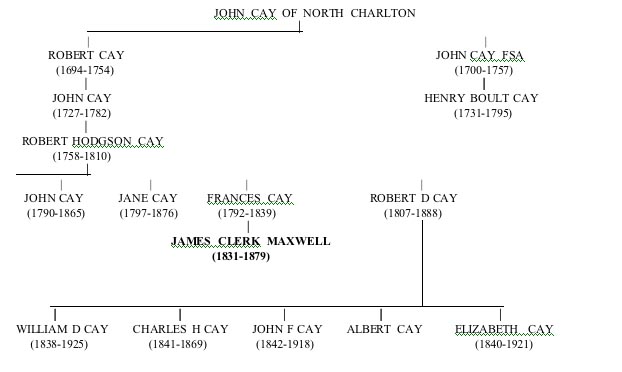
John Cay, FSA (1700-57)
John Cay (1700-1757)) was a distinguished barrister and antiquary. He was elected a Swain of the Order of Antiquaries in 1736, some eleven years after Sir John Clerk (2nd Baronet) and the two may have met at meetings of the Social club.
Henry Boult Cay (1731-1795)
The son of John Cay, FSA, Henry Boult Cay, Second Wrangler in 1752, was subsequently elected a Young man of Clare College, Cambridge (Victorian epitome of the college). His professional career was equally a barrister, Deputy Steward of the Marshalsea and Steward of the State Court of Middlesex.
Robert Hodgson Cay, LL. D. (1758-1810)
Robert Hodgson Cay, James Clerk Maxwell's grandpa, was called to the Scottish Bar in 1780. He was the Commissary of Edinburgh and then Judge of the High Court of Admiralty and was well acquainted with Sir Walter Scott. He would doubtless too take been well acquainted with Lord Eldin with whom he was a contemporary.
John Cay, FRSE (1790-1865)
John Cay was James Clerk Maxwell'due south favourite uncle and one of his father's closest friends. He had been educated at the High School in Edinburgh and the University of Edinburgh. He was called to the Bar in 1812, the twelvemonth subsequently James Clerk Maxwell's father, John Clerk Maxwell. In 1812 he was elected a Young man of the Royal Social club of Edinburgh (the same year as John Clerk Maxwell). He had an enthusiasm for the acquisition of scientific knowledge and although not specially trained in mathematics was extremely skilled in arithmetic and fond of calculation every bit a voluntary pursuit - his involvement in these areas acting every bit an inspiration to James Clerk Maxwell. His wide ranging interests included membership of the Scottish Society of Arts of which trunk he was the President from 1848-1849. For some 43 years (1822 and 1865), he was the Sheriff of Linlithgow. He was a "audio and judicious judge who discharged his duties with keen credit to himself and great satisfaction to the public."
Robert Dundas Cay (1807-1888)
Robert Dundas Cay (1807-1888), Writer to the Signet, another uncle of Clerk Maxwell, was the Registrar to the Supreme Court of Hong Kong. His brother-in-law was the artist Sir William Dyce R.A.
William Dyce Cay, FRSE, MICE (1838-1925)

>William Dyce Cay (cousin of JCM).
William Dyce Cay was 1 of the sons of Robert Dundas Cay and was James Clerk Maxwell's cousin. He had studied at Edinburgh Academy where he won the highest mathematical prize, the Straiton Golden Medal, in 1856. Between 1856 and 1858 he served his pupilage in engineering in Belfast with Lord Kelvin's blood brother, James Thomson, whose ingenuity James Clerk Maxwell has in one case described every bit "quite equal to that of his blood brother." In 1872 he was elected a Member of the Institution of Civil Engineers and in 1882 a Fellow of the Majestic Society of Edinburgh. He was an proficient on the construction of harbours and for many years was the resident engineer at Aberdeen Harbour. He made numerous contributions to engineering journals.
Charles Hope Cay 1841-1869)

Charles Hope Cay (cousin of JCM).
William's blood brother Charles H. Cay was educated, like Clerk Maxwell, at the Edinburgh University where he won the Mathematics Medal in 1857. Possessed of a versatile intellect he was undecided whether to study classics or mathematics when he proceeded to Caius Higher, Cambridge, on a classics scholarship in 1860. He opted for mathematics, graduating as 6th Wrangler in 1864 and being elected a Fellow of Caius College in the same yr. He proceeded to Clifton College equally Mathematics Main but died at the tragically young age of twenty-8, his potential unfulfilled. It was to Charles Hope Cay that Clerk Maxwell wrote, "I have also a paper adrift, with an electromagnetic theory of low-cal, which, till I am convinced to the contrary, I hold to be great guns." Perhaps but to his favourite cousin would Clerk Maxwell have vouchsafed such a personal opinion of his own work
Elizabeth Cay (1840-1921)
It is reputed that Clerk Maxwell had been addicted of his cousin Elizabeth (1840-1921), a beautiful and highly intelligent girl, but for reasons of consanguinity this zipper was not pursued. Elizabeth ('Lizzie') married Thomas William Dunn who graduated in 1864 with First Class honours in the Cambridge Classical Tripos and was elected as a Fellow of Peterhouse College. He was the Headmaster of Bath College from 1878 to 1897. The Cambridge tradition was kept upwardly through Lizzie'due south daughter Mary who married Peter Giles, later Master of Emmanuel College (Victorian image of the college), and through her son Charles, classical scholar of Trinity College.
James Clerk Maxwell FRS, FRSE (1831-1879)

P.G. Tait
The confluence of the seventh generation of Clerks and the sixth generation of Cays in the form of James Clerk Maxwell produced the greatest Clerk and Cay of them all, but that was non fully evident early on. Measured against the qualities of his relatives and friends Clerk Maxwell'southward success as Second Wrangler and Get-go Smith'south prizeman in 1854 was not, at that stage of his career, and so remarkable given the achievements of the Blackburns, the Mackenzies, the Cays and his schoolhouse friends at the Edinburgh Academy (P.G. Tait — Senior Wrangler and Offset Smith'southward prizeman (1852); A. Stewart — 9th Wrangler (1853); R. Campbell — Fourteen Wrangler (1854)). What was so remarkable was the luminescence, as a whole, of the grouping of which Clerk Maxwell was a fellow member. It was extraordinary that the just ii Offset Smith'south prizemen to come up from the Edinburgh Academy were both built-in in the same twelvemonth and attended the school at the same time (although in unlike classes).
The Blackburns, Mackenzies, Cays, Clerk Maxwell (and some fifteen of Clerk Maxwell's forty first cousins) had attended the Edinburgh Academy and had come under the influence of the mathematics master Mr. Gloag. Gloag had some 10 Wranglers to his credit including i Senior (Tait) and 2 Seconds (Clerk Maxwell and Mackenzie). Gloag took great pride in the achievements of his old pupils; indeed when a dinner was held for Tait to celebrate his Senior Wranglership, Gloag was invited and "was then beside himself that information technology was difficult for the casual onlooker to discern whether it was Tait or Gloag who had been Senior Wrangler'. Tait's view on the footing of Gloag'south success as a teacher would hardly have accorded with modern cultural attitudes. He said, "To utilise a well known cricketing phrase, Gloag could get more than work on the tawse than any other primary. His secret was in large measure out a dynamical i."
Maxwell showed talents which could exist traced to the creative abilities of the Cays and the special genius of the Clerks. The 'special genius' runs through the generations of the Clerks like a common thread — bang-up ability, originality, intense marvel and acquisition of knowledge in a wide range of fields. The public statements which were made about Maxwell ofttimes had their counter-parts in statements which had been made near others in the long line of Clerks. For example it was said re John Clerk of Eldin, swell slap-up uncle: "His extensive information is at the service of every stranger who is introduced and is and so general and miscellaneous that anybody must find a subject of entertainment and data" and about James Clerk Maxwell: "He showed himself acquainted with every bailiwick on which the chat turned. I never met a man like him. I exercise not believe there is not a single subject on which he cannot talk and talk well to, displaying ever the well-nigh curious and out-of-the-way information."
Similarly about re Sir John Clerk, his neat great grandad, that he was a "human being of taste and genius" and virtually John Clerk of Eldin, his great nifty uncle: "One of those men who by the force of their ain genius. . . ." Comparer what was said about James Clerk Maxwell: "Everyone of his works is stamped with the subtle but unmistakable impress of genius" and about his cousin Jemima Blackburn (née Wedderburn): "She volition not be displeased at hearing by what critics her genius is appreciated."
Another example: near John Clerk of Eldin, Maxwell's great great uncle, it was said that "he possessed a stiff and inventive heed to which the honey of knowledge and the pleasance derived from the acquisition of it were always sufficient motives for awarding" and about John Clerk, Lord Eldin, the son of smashing not bad uncle: "He was remarkable both for his acuteness, marvellous powers of reasoning and fertility of resource." Compare the following well-nigh James Clerk Maxwell: "To those who could catch a few sparks that flashed every bit he thought aloud or when he twinkled with wit and proffer he was supreme equally an inspiration."
The Genius of James Clerk Maxwell

John Clerk Maxwell (begetter of JCM) and Mrs Frances Maxwell (née Cay) (with son, James Clerk Maxwell)
Having inherited the special genius, originality and artistic ability of the Clerks every bit well as the abilities of the Cays it is not surprising that James Clerk Maxwell had a superb and wide ranging intellect as well equally physical intuition and geometrical imagination of the very highest lodge.
His private tutor at Cambridge, William Hopkins said: "It appears incommunicable for Maxwell to think incorrectly on physical subjects."
Professor Coulson said: "at that place is scarcely a single topic that he touched upon which he did not change almost beyond recognition."
Peter Guthrie Tait said in 1879 in his obituary tribute to Clerk Maxwell: "he had 1 of the nearly piercing intellects of modern times."
Through his pioneering contributions to the Kinetic Theory of Gases, the Theory of Color, the Theory of Saturn's Rings, Thermodynamics, Elasticity and Eyes and in particular through his Theory of Electromagnetism James Clerk Maxwell ranks along with Newton and Einstein every bit one of the greatest men in the history of scientific discipline.

John Clerk Maxwell
The bridge of Clerk Maxwell'southward work was enormous. Only three examples of it can be mentioned hither.
ane. Colour Photography: The first colour photograph always taken was taken past Clerk Maxwell in 1861. Maxwell's work on color had confirmed the theories of Young and of Helmholz, namely that all colours could be made past calculation together three basic or principal colours which Maxwell took as red, blue and dark-green - the so called tri-chromatic theory of low-cal. Maxwell considered that the tri-chromatic theory could be cleverly illustrated by photography and arranged for three photographs to be taken of a tartan ribbon. The kickoff photo was taken through a red filter, the 2d through a blueish filter and the tertiary through a greenish filter. The hugger-mugger was and so to project the 3 photographs back on to the screen, the red photo being projected back through a red filter, the blue the blueish filter and so on, the movie being reassembled over again from the three primary colours
It turns out that Maxwell'due south photographic experiment should non have worked and that he was extremely lucky to obtain a coloured photograph at all. The photographic plate which he used was not sensitive to ruby-red light and no photograph should have appeared when the ribbon was photographed in ruby-red light but by a stroke of luck the red colour in the ribbon as well reflected ultraviolet light to which the photographic plate was sensitive. Instead of photographing the ribbon under red light Maxwell was actually photographing information technology under ultraviolet low-cal so the mixture of colours which Maxwell obtained was ultraviolet, blueish and blue-green, not the mixture red, bluish, green he believed he had obtained. Maxwell made his color photograph at least 20 years alee of the fourth dimension when it should have been possible, such was the fashion of his genius.
2. Saturn's Rings: The 2d topic concerns Saturn's rings and the Adams Prize which was set in 1855. The subject of the Adams prize was 'the motions of Saturn's rings' and the problem was to ascertain whether: 1. the rings were solid bodies, regular or irregular; two. the rings were fluid bodies, liquid or gaseous; 3. the rings were composed of disconnected masses. Clerk Maxwell responded to the prize contest by submitting in 1857 an essay entitled, 'On the Stability of Move of Saturn'southward Rings' and won the Adams prize.
It was known prior to Maxwell's essay that the rings could not be a compatible solid ring considering the dynamical equilibrium of a solid compatible ring would exist unstable and it therefore would crash into the planet. Maxwell proved that it was possible for the ring to be a not-uniform solid body merely it would have to have virtually exactly 82 per cent of the weight of the ring in one lump on the side of the ring. Observations showed such an irregularity in the structure of the ring did not exist and therefore this possibility was discounted. He showed furthermore that if the rings were a fluid then waves would be formed in the ring which would result in the ring breaking upwards. He concluded therefore that the ring could merely be a series of disconnected masses. The essay which he wrote in 1857 was over eighty pages long and was described past Professor Airy, the Astronomer Regal, every bit one of the finest applications of mathematics to physics that he had ever seen.
three. Electromagnetism: Maxwell's Theory of Electromagnetism, and his peachy contributions to the Kinetic Theory of Gases and other areas of physics, were the outcome of enquiry of the highest order and constituted major contributions to scientific cognition. His derivation of the famous Maxwell's equations and his deduction that lite was an electromagnetic moving ridge is more often than not held to take been the greatest advance in physics since the time of Newton and have resulted in Maxwell's name being historic throughout the world.
While the famous equations which Clerk Maxwell derived to describe the electro-magnetic field are universally known as Maxwell'southward equations and will no doubt remain that way for all time maybe they would be better named the Clerk-Cay equations equally a plumbing equipment tribute to the remarkable families from which he came.
Bibliography
Brown, I. 1000. The Clerks of Penicuik. Penicuik House Preservation Trust, Edinburgh, 1987.
Terminal modified 24 March 2006
Source: https://victorianweb.org/science/maxwell/forfar2.html
0 Response to "Who Is James Maxwell's Family Who Is James Maxwell's Family"
Publicar un comentario