Economic History of the Cold War Era Changed Because of the Baby Boom and Inventions
The Post-War Boom
The menstruum following World War II saw increased prosperity for many Americans.
Learning Objectives
Clarify the era of U.Due south. prosperity following World War Ii
Fundamental Takeaways
Fundamental Points
- The years immediately following World War II witnessed stability and prosperity for many Americans. The U.S. economic system grew dramatically; expanding at a charge per unit of 3.5% per annum betwixt 1945 and 1970.
- Between 1946 and 1960, the U.s. witnessed a significant expansion in the consumption of goods and services. Gross national product rose by 36% and personal consumption expenditures by 42%.
- Many socioeconomic changes, including higher and more than secure wages, admission to paid vacation, Social Security and private pension plans, and more educational opportunities, shaped the life of many working-class families that transitioned to the center-form standard of living.
- Many city dwellers chose a suburban life way centered on children and housewives, with the male breadwinner commuting to work. Bourgeoisie housed a third of the nation'south population past 1960.
- The rapid social and technological changes brought a growing corporatization of America and the decline of smaller businesses.
- Despite the fast mail-WWII economical growth, a significant proportion of Americans continued to live in poverty, including a large number of African-American families.
Key Terms
- baby blast: Whatever period marked by a profoundly increased fertility charge per unit. This demographic phenomenon is usually ascribed within sure geographical premises. In the United States, the post-WWII flow was marked by this miracle.
- suburbia: Residential or mixed-apply areas, either existing as function of a city or urban expanse or every bit a separate residential community within commuting distance of a city. In most English language-speaking regions, these areas are defined in dissimilarity to central or inner urban center areas. Their fast growth was an of import component of the mail service-WWII U.S. economic boom.
Mail service-War Prosperity
The years immediately following World State of war II witnessed stability and prosperity for many Americans. Increasing numbers of workers enjoyed loftier wages, larger houses, better schools, more than automobiles, and home comforts like vacuum cleaners and washing machines, which were made for labor-saving and to brand housework easier. Inventions familiar in the early 21st century made their offset appearance during this era.
The U.Southward. economy grew dramatically in the post-war period, expanding at a rate of 3.5% per annum betwixt 1945 and 1970. During this period, many incomes doubled in a generation; a phenomenon that economist Frank Levy described as "upward mobility on a rocket ship." The substantial increase in boilerplate family income within a generation resulted in millions of part and factory workers being lifted into a growing middle course, enabling them to sustain a standard of living once considered reserved for the wealthy. As noted by Deone Zell, assembly line work paid well, while unionized factory jobs served as "stepping-stones to the middle class." By the terminate of the 1950s, 87% of all U.S. families owned at least 1 television receiver, 75% owned automobiles, and 60% endemic homes. By 1960, blueish-collar workers had become the most prolific buyers of many luxury goods and services. Additionally, by the early 1970s, post-Globe War 2 U.S. consumers enjoyed college levels of disposable income than those in any other country.
Economic Growth
The post-state of war years were also noted for the rise of the automotive and aviation industries. Many wartime industries continued to carry business following World War 2, driving innovation in newer industries such as aerospace and manufacturing. As companies grew in size, jobs, manufacturing plant production, and consumer spending rose with it. Between 1946 and 1960, the United States saw greatly increased consumption of goods and services. Gross national product rose by 36% and personal consumption expenditures past 42%, with cumulative gains reflected in the incomes of families and unrelated individuals. While the number of these family units rose sharply from 43.iii million to 56.one meg in 1960, a rise of about 23%, their boilerplate incomes grew even faster, from iii,940 in 1946 to 6,900 in 1960; a 43% increase. After taking inflation into account, the real advance was sixteen%.
More than 21 million housing units were synthetic between 1946 and 1960, and in the latter yr, 52% of consumer units in metropolitan areas were homeowners. In 1957, out of all the wired homes throughout the state, 96% had a refrigerator, 87% an electric clothes washer, 81% a television set, 67% a vacuum cleaner, 18% a freezer, 12% an electric or gas apparel dryer, and viii% air conditioning. Car ownership likewise soared, with 72% of consumer units owning an automobile past 1960.
The menstruation from 1946 to 1960 likewise saw a substantial increase in paid leisure fourth dimension of working people. The 40-hour workweek established by the Fair Labor Standards Act in covered industries became the bodily schedule in most workplaces by 1960. The majority of workers as well enjoyed paid vacations and industries catering to leisure activities blossomed.
Educational outlays were too greater than in other countries, while a higher proportion of young people graduated from high schools and universities compared with elsewhere in the earth, as hundreds of new colleges and universities opened every year. At the advanced level, U.Southward. science, engineering, and medicine were earth-renowned.
In regard to social welfare, the post-war era saw a considerable comeback in insurance for workers and their dependents confronting the risks of illness, every bit private insurance programs like Bluish Cross and Blue Shield expanded. With the notable exception of subcontract and domestic workers, Social Security covered virtually all members of the labor forcefulness. In 1959, well-nigh two-thirds of factory workers and three-fourths of part workers were provided with supplemental private pension plans.
Many city dwellers gave up cramped apartments for a suburban lifestyle centered on children and housewives, with the male breadwinner commuting to work. Suburbia encompassed a third of the nation's population past 1960. Suburban growth was not merely a effect of post-war prosperity, simply innovations of the single-family unit housing market with depression interest rates on 20- and xxx-year mortgages and low downward payments, particularly for veterans. William Levitt began a national trend with his use of mass-production techniques to construct a big Levittown housing evolution on Long Island, NY. Meanwhile, the suburban population swelled because of the baby boom, which was a dramatic increase in fertility in the period of 1942–1957.
Corporatization
The rapid social and technological changes brought a growing corporatization of the United States and the decline of smaller businesses, which often suffered from high post-war aggrandizement and mounting operating costs. Newspapers declined in numbers and consolidated. The railroad industry, once 1 of the cornerstones of the U.S. economy and an immense and oft scorned influence on national politics, also suffered from explosive automobile sales and the construction of the interstate system. By the end of the 1950s, it was well into decline and by the 1970s became completely broke, necessitating a federal government takeover. Smaller automobile manufacturers such as Nash, Studebaker, and Packard were unable to compete with the so-called Large Three (Full general Motors, Ford, and Chrysler) in the new post-war world and gradually declined into oblivion. Suburbanization caused the gradual motility of working-course people and jobs out of the inner cities as shopping centers displaced the traditional downtown stores. In time, this would have disastrous effects on urban areas.
The Excluded
The new prosperity did not extend to anybody. Many Americans continued to live in poverty throughout the 1950s, especially older people and African Americans, the latter of whom connected to earn far less than their white counterparts on boilerplate in the two decades following the cease of World War Two. Immediately after the state of war, 12 million returning veterans were in need of piece of work and in many cases could not find it. In improver, labor strikes rocked the nation; in some cases exacerbated by racial tensions due to African-Americans having taken jobs during the war and now being faced with irate returning veterans who demanded that they step aside. The huge number of women employed in the workforce in the war were also rapidly cleared out to make room for men.
Between one-fifth and one-fourth of the population could non survive on the income they earned. The older generation of Americans did non benefit as much from the post-war economic blast, especially every bit many had never recovered financially from the loss of their savings during the Great Depression. Many blue-collar workers continued to live in poverty, with 30% of those employed in industry. Racial differences were staggering. In 1947, lx% of black families lived below the poverty level (defined in one study as beneath $3,000 in 1968), compared with 23% of white families. In 1968, 23% of black families lived below the poverty level, compared with ix% of white families.

Suburbia: Aerial view of Levittown, Pennsylvania, circa 1959.
The K.I. Bill of Rights
The G.I. Bill offered returning World War 2 veterans important benefits that had a great impact on socioeconomic changes in the post-war era.
Learning Objectives
Compare and contrast the benefits awarded through the G.I. Bill to veterans of Globe War II and of the Korean State of war
Primal Takeaways
Cardinal Points
- The G.I. Bill was a law that provided a range of benefits for returning World War Ii veterans. Benefits included low-toll mortgages, low-interest loans to first a business concern, greenbacks payments of tuition and living expenses to attend university, high school or vocational education, also equally 1 year of unemployment compensation.
- Past the end of the program in 1956, roughly ii.ii million veterans had used the GI Bill education benefits to attend colleges or universities. An additional 5.6 one thousand thousand used these benefits for vocational training programs.
- Although the K.I. Neb did not specifically abet discrimination, information technology was interpreted differently for African Americans. Because the programs were directed past local, white officials, many veterans of color did non benefit.
- The success of the G.I. Neb prompted the regime to offer similar measures to later generations of veterans. The Veterans' Adjustment Deed of 1952 offered benefits to veterans of the Korean State of war who served for more than ninety days and had received an "other than dishonorable discharge."
- Despite the racial discrimination that the legislation embraced, the G.I. Neb proved extremely constructive for white veterans, enabling many to transition into the middle course.
Primal Terms
- 52–20 Club: A provision of the 1944 K.I. Bill that enabled all former servicemen to receive $20 of unemployment benefits per week for 52 weeks/twelvemonth while they were looking for work.
- The Veterans' Adjustment Act of 1952: A police force (signed July sixteen, 1952) that offered offered benefits to veterans of the Korean War who served for more than 90 days and had received an "other than dishonorable discharge."
- G.I. Bill: A law that provided a range of benefits for returning World State of war 2 veterans. It was available to every veteran who had been on active duty during the war years for at least 90 days and had non been dishonorably discharged. Combat was non required.
Globe State of war II Veterans
The Servicemen'southward Readjustment Act of 1944, known informally as the G.I. Nib, was a police force that provided a range of benefits for returning World War Ii veterans (commonly referred to as K.I.due south). Benefits included low-cost mortgages, depression-interest loans to start a business, cash payments of tuition and living expenses to attend university, loftier schoolhouse, or vocational education, and 1 year of unemployment compensation. It was bachelor to every veteran who had been on agile duty during the war years for at to the lowest degree 90 days and had not been dishonorably discharged. Combat was not required. By the end of the program in 1956, roughly 2.2 million veterans had used the G.I. Neb education benefits so they could enroll in colleges or universities. An additional 5.6 million used the benefits for vocational training programs.
On June 22, 1944, President Franklin Roosevelt signed the Servicemen's Readjustment Act of 1944 into police. Roosevelt wanted a postwar assist plan to help transition from wartime, but he also wanted it on a need-footing for poor people, not just veterans. The veterans' organizations mobilized support in Congress that rejected Roosevelt's approach and provided benefits only to veterans of military service; both men and women. The bill was introduced in the House on January x, 1944, and in the Senate the post-obit twenty-four hour period; both chambers approved their own versions.
An important provision of the G.I. Beak was low-involvement, zero-down-payment habitation loans for servicemen, with more than favorable terms for new construction compared with those for existing housing. This encouraged millions of American families to move out of urban apartments and into suburban homes. Another provision was known as the 52–20 clause. This enabled all erstwhile servicemen to receive $20 a calendar week for 52 weeks/yr while they were looking for piece of work. Less than 20% of the money set aside for the 52–20 Club was distributed; rather, most returning servicemen speedily found jobs or pursued higher didactics.
Discrimination
Although the Yard.I. Bill did not specifically advocate bigotry, information technology was interpreted differently for African Americans. Historian Ira Katznelson argued that "the law was deliberately designed to accommodate Jim Crow." Considering the programs were directed by local, white officials, many veterans did not benefit. Of the first 67,000 mortgages insured past the G.I. Bill, fewer than 100 were taken out by Americans of colour. By 1946, only i fifth of the 100,000 African Americans who had practical for educational benefits had registered in college. Furthermore, historically blackness colleges and universities (HBCUs) came nether increased force per unit area every bit rising enrollments and strained resources forced them to turn away an estimated 20,000 veterans. HBCUs were already the poorest colleges, and their resources were stretched fifty-fifty thinner when veterans' demands necessitated a shift in the curriculum away from the traditional "preach and teach" course of study HBCUs offered.
The United states of america Department of Veterans Affairs, because of its strong affiliation to the all-white American Legion and Veterans of Foreign Wars, likewise became a formidable foe to many African Americans in search of an educational activity, considering information technology had the power to deny or grant the claims of black G.I.s. Additionally, banks and mortgage agencies refused loans to African Americans, making the G.I. Pecker even less effective for Americans of color.

G.I. Bill Instruction: Worksheets from diverse areas of study embrace the desk-bound of a Joint Task Force Trooper. The Servicemen'south Readjustment Act, commonly referred to equally the G.I. Beak, helped service members pay for college education and training programs since it was signed into law by President Roosevelt on June 22, 1944.
Korean War Veterans
The success of the 1944 G.I. Bill prompted the government to offer similar measures to later generations of veterans. The Veterans' Adjustment Human action of 1952, signed into law on July sixteen, 1952, offered benefits to veterans of the Korean War who served for more than 90 days and had received an "other than dishonorable discharge." Korean War veterans did not receive unemployment compensation but were entitled to unemployment compensation starting at the end of a waiting menstruation determined by the amount and disbursement dates of their mustering-out pay. They were entitled to 26 weeks at $26/week to be paid for past the federal government, just administered past united states of america. One improvement in the unemployment bounty for Korean State of war veterans was they could receive both state and federal benefits; the federal benefits beginning once country benefits were exhausted.
One significant divergence between the 1944 Yard.I. Bill and the 1952 Act was that tuition was no longer paid straight to the called institution of higher education. Instead, veterans received a stock-still monthly sum of $110, from which they had to pay for their tuition, fees, books, and living expenses. The determination to end direct tuition payments to schools came after a 1950 House select committee uncovered incidents of overcharging of tuition rates past some institutions under the original Grand.I. Beak in an endeavor to defraud the government.
Congress did not include merchant marine veterans in the original G.I. Bill, even though they are considered military personnel in times of war, in accord with the Merchant Marine Human action of 1936.
Bear upon
Despite the racial bigotry that the legislation embraced, the K.I. Bill proved highly constructive for white veterans. Over half of the World War II veterans benefited from educational benefits of the bill, and past 1947, nigh one-half of higher enrollments were veterans. Almost a third of all veterans accessed low-interest loans. With the mail service-war economical smash and very low unemployment rates, relatively few depended on unemployment benefits. These opportunities allowed many veterans to transition into the middle course and secure economic prosperity.
Veterans also fought for higher education programs more focused on practical needs, which led to increased valuing of more pragmatic programs such as engineering. A higher education, and the resultant higher salary, was no longer limited to the U.South. economic elite. Average federal income rose along with average U.S. taxpayer income. Colleges also benefited from the influx of veterans: increased enrollments meant more coin for institutions to operate.
A big demand for housing followed from the 1000.I. Bill'south mortgage subsidies, leading to the expansion of suburbs and the new U.Southward. middle grade. Historians have argued that the bill had a tremendous touch on the dramatic stride of the mail service-war growth of housing and suburbia.
The Revival of Domesticity and Faith
U.S. post-state of war economic prosperity collection much higher nascence rates and pushed many women dorsum into the domestic sphere; this coincided with an increase in organized faith.
Learning Objectives
Examine the factors that contributed to the revival of domesticity and religion in the years post-obit World War 2
Cardinal Takeaways
Key Points
- The decade following Earth War II was characterized by increasing wealth throughout much of U.Southward. society. As economical prosperity empowered couples who had postponed matrimony and parenthood, the birth rate began to shoot up in 1941, peaking in the late 1950s; a phenomenon known as the post-state of war babe blast.
- Every bit men's return from armed services service had forced many women out of the labor market place, many chafed at the social expectations of being relegated to a stay-calm housewife who cooked, cleaned, shopped, and tended to the children.
In the 1950s, membership in churches increased significantly, and the growing popularity of organized religion shaped the daily life of Americans and shaped U.S. politics. - As the resurgence of organized organized religion connected to grow in the United States, a number of landmark Supreme Court cases addressed the issue of separation of church and state.
Fundamental Terms
- baby smash: Any period marked past a greatly increased fertility rate. This demographic phenomenon is ordinarily set within sure geographical bounds. The phenomenon marked the post-World War II period in the United States.
- fundamentalist: One who reduces religion to strict interpretation of core or original texts.
- Everson v. Lath of Teaching: This 1947 Supreme Court case dealt with a New Jersey law that immune government funds to be used for transportation to religious-oriented schools. Though the ruling was upheld, this was the first case in which the court applied the Establishment Clause to country law, having interpreted the due process clause of the Fourteenth Subpoena equally applying the Beak of Rights to the states as well every bit the federal legislature.
- Engel v. Vitale: This 1962 Supreme Courtroom example determined it was unconstitutional for state officials to compose an official schoolhouse prayer and require its recitation in public schools, even when the prayer was non-denominational and students could excuse themselves from participation.
The Baby Boom and the Role of Women
The decade following Earth War II was characterized past growing wealth throughout much of U.S. lodge. The U.S. economy grew dramatically, expanding at an annual rate of 3.5% between 1945 and 1970. As economical prosperity empowered couples who had postponed marriage and parenthood, the birth rate began to shoot up in 1941, paused in 1944–'45 (with 12 1000000 men in service), and so continued to soar until peaking in the tardily 1950s; a phenomenon known every bit the mail service-war infant boom.
In 1946, live births in the United states of america surged from 222,721 in January to 339,499 in October. Past the end of the 1940s, virtually 32 million babies had been built-in, compared with 24 million in the 1930s. In May 1951, Sylvia Porter, a New York Mail service columnist, first used the term "blast" to refer to the phenomenon of increased births in the mail service-war United States. Annual births first topped 4 million in 1954, and did not drop below that figure until 1965, by which fourth dimension four in 10 Americans were under age 20.
Many factors contributed to the baby boom. In the post-war years, couples who could not afford to enhance a family unit during the Great Depression made upwards for lost fourth dimension; the mood was at present optimistic. During the war, unemployment ended and the economic system greatly expanded. Millions of veterans returned home and were forced to reintegrate into gild. To facilitate this process, Congress passed the G.I. Nib, which, through the distribution of loans to veterans at low or no interest rates, encouraged home ownership and investment in higher instruction. The G.I. Pecker enabled record numbers of people to end loftier schoolhouse and attend higher. This led to increasingly skilled workers and yielded college incomes for families.
Returning veterans married, started families, pursued college educational activity, and bought their outset homes. With veterans' benefits, the 20-somethings found new homes in planned communities on the outskirts of U.S. cities. Marriage rates rose sharply in the 1940s and reached all-time highs for the country. Americans began to marry at a younger age: the average age at start spousal relationship dropped to 22.5 years for males and xx.1 for females; downwardly from 24.3 for males and 21.5 for females in 1940. Getting married immediately subsequently high school was condign commonplace, and women were increasingly under tremendous pressure to ally by the age of twenty. The stereotype developed that women were going to higher to earn their M.R.Due south. (Mrs.) degree.
The role of women in U.Southward. society became an effect of particular interest in the post-war years, with marriage and feminine domesticity depicted equally the main goal for the country'southward women. As men'south return from military service had forced many women out of the labor market, many chafed at the social expectations of being relegated to a stay-at-domicile housewife who cooked, cleaned, shopped, and tended to the children. In 1963, Betty Friedan published her book, The Feminine Mystique, which strongly criticized the office of women during the postwar years and was a best-seller and a major goad of the women's liberation movement.
Religious Resurgence
As the birth rate soared, families grew, and more people moved to the suburbs, the United states of america witnessed a subsequent blast in amalgamation with organized religion, especially involving various Protestant churches. Between 1950 and 1960, church membership among Americans increased from 49% to 69%. Religious messages began to infiltrate popular civilisation every bit religious leaders became famous faces and numerous religious organizations were formed. Institutionalized religion became such a disquisitional aspect of U.S. life that information technology came to shape major political decisions. Although in 1948, Dwight Eisenhower referred to himself as "i of the most deeply religious men [he knew]," yet unattached to whatsoever "sect or organization," he decided to get baptized in the Presbyterian Church building in 1953, the outset year of his presidency. A yr later, Congress added the words "nether God" to the Pledge of Fidelity.
The 1950s saw a nail in the Evangelical Church in the United States. The post-World War II prosperity experienced in the country also affected the church. Church buildings were erected in large numbers, and the Evangelical Church's activities grew along with this sweeping physical growth. In the southern United States, the Evangelicals, represented by leaders such as Billy Graham, experienced a notable surge, displacing the caricature of the pulpit-pounding country preachers of fundamentalism as stereotypes gradually shifted. Graham began the trend of national celebrity ministers who circulate to megachurches via radio and tv. He is also notable for having been a spiritual adviser to several U.Due south. presidents, including Eisenhower and Richard Nixon.
In the post-World War 2 menses, a split adult amid Evangelicals. Many began to express reservations about being known to the earth as fundamentalists. The term neo-evangelicalism was coined in 1947 to identify a distinct movement inside cocky-identified fundamentalist Christianity. The new generation of Evangelicals gear up their goal every bit abandoning a militant Bible opinion. Instead, they would pursue dialogue, intellectualism, nonjudgmentalism, and appeasement. They further called for increased awarding of the gospel to sociological, political, and economic issues. Additionally, Christianity Today was first published in 1956; a year that also marked the beginning of the Bethany Fellowship, a minor press that grew to exist a leading evangelical printing. The cocky-identified fundamentalists also cooperated in separating their "neo-Evangelical" opponents from the fundamentalist title, by increasingly seeking to distinguish themselves from the more open group, whom they oftentimes characterized derogatorily equally neo-Evangelical or just Evangelical.
The Conservative Baptist Clan also emerged in 1947 as role of the continuing Fundamentalist–Modernist Controversy within the Northern Baptist Convention. The forming churches were fundamentalist/conservative churches that had remained in cooperation with the Northern Baptist Convention after other churches had left, such as those that formed the Full general Association of Regular Baptist Churches.
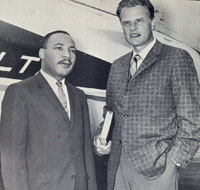
Reverends King and Graham: A photo of pop Christian Reverend Baton Graham with Martin Luther King Jr.
Separation of Church and Country
As the resurgence of religion continued in the Us, a number of landmark Supreme Court cases addressed the outcome of separation of church and state. The centrality of the separation concept to the Religion Clauses of the Constitution was made explicit in Everson 5. Lath of Education (1947), a case that dealt with a New Bailiwick of jersey law that allowed government funds to be used for transportation to religious-oriented schools. Though the ruling was upheld, this was the start case in which the Court applied the Establishment Clause to state police, having interpreted the due procedure clause of the Fourteenth Amendment equally applying the Bill of Rights to the states as well as the federal legislature. Citing Thomas Jefferson, the court concluded that, "The First Subpoena has erected a wall between church building and state. That wall must be kept loftier and impregnable. We could not corroborate the slightest alienation."
In 1962, the Supreme Court addressed the issue of officially sponsored prayer or religious recitations in public schools. In Engel five. Vitale (1962), the Court deemed it unconstitutional for state officials to etch an official school prayer and require its recitation in public schools, even when the prayer was non-denominational and students could excuse themselves from participation.
Technological Advancement
After 1945, new technologies resulted in revolutionary changes in agriculture, space manufacture, and medical sciences in the United States.
Learning Objectives
Evaluate the advances in technology post-obit World State of war Two, and how these influenced the farming, infinite, and medical industries
Fundamental Takeaways
Cardinal Points
- In the aftermath of World War II, technological developments greatly influenced changes in agriculture. Agronomics began to move from small, family-endemic farms to large, corporate-owned farms.
- In the 1950s, 77% of households purchased their first tv set and the television receiver manufacture noted dramatic growth, with many classic shows and formats developed by legendary personalities.
- Although the Space Race can trace its origins to Germany in the 1930s, it was a disquisitional component of the Cold War. The Soviet launch of Sputnik I led to a huge fasten in U.S. technological and industrial productivity.
- In medical sciences, the discovery of the polio vaccine and mass product of penicillin revolutionized the notion of public health.
- The first successful open heart procedure on a man using a heart–lung machine and the globe's first successful renal transplant took place less than x years afterwards the end of Earth War Ii.
Key Terms
- Infinite Race: A 20th-century competition between the ii Cold State of war rivals – the Soviet Union and the The states – for supremacy in spaceflight capability. Information technology had its origins in the missile-based nuclear arms race between the two nations that occurred following World War Two, enabled by captured High german rocket technology and personnel. The technological superiority required for such supremacy was seen as necessary for national security, and symbolic of ideological superiority. Information technology spawned pioneering efforts to launch artificial satellites, unmanned space probes of the Moon, Venus, and Mars, and man spaceflight in low Globe orbit and to the Moon.
- Sputnik I: The Soviet Marriage launched this first artificial world satellite into an elliptical low Globe orbit on October 4, 1957. The surprise success precipitated the U.S. Sputnik crunch, began the Space Age, and triggered the Space Race, a part of the larger Cold War. The launch ushered in new political, war machine, technological, and scientific developments.
- Apollo Program: A U.Southward. human spaceflight program carried out by the National Aeronautics and Infinite Administration (NASA) that landed the offset humans on Globe's Moon in 1969–1972. Conceived during the presidency of Dwight Eisenhower, it began in earnest after President John Kennedy in a May 25, 1961 address to Congress proposed the national goal of "landing a human on the Moon and returning him safely to the Earth" past the end of the 1960s.
- NASA: This bureau of the U.S. government is responsible for the nation's noncombatant infinite program and for aeronautics and aerospace research.
- Green revolution: Research and development of technology transfer initiatives occurring between the 1930s and the late 1960s (with prequels in the piece of work of the agrestal geneticist Nazareno Strampelli in the 1920s and 1930s), which increased agricultural production worldwide.
Advocacy in Agriculture
In the aftermath of World War Two, technological developments profoundly influenced changes in agriculture. Ammonia from plants built during World War II to brand explosives became available for making fertilizers, leading to a permanent turn down in fertilizer prices. The early 1950s was the peak period for tractor sales in the Usa, as the few remaining horses and mules were phased out. The horsepower of farm machinery greatly increased. An effective cotton-picking motorcar was introduced in 1949. Inquiry on plant convenance produced varieties of grain crops that could produce high yields with heavy fertilizer input. These advancements resulted in the Green revolution that began in the 1940s.
A continued increase in productivity led to further increases in farm size and corresponding reductions in the number of farms. Many farmers sold their land and moved to nearby towns and cities. Others transitioned to part-fourth dimension operation, supported past off-subcontract employment.
Tv set
Past 1947, when in that location were 40 meg radios in the United states of america, at that place were virtually 44,000 boob tube sets (with probably 30,000 in the New York area). Regular network idiot box broadcasts began on NBC on a iii-station network linking New York with the Upper-case letter District and Philadelphia in 1944, on the DuMont Television Network in 1946, and on CBS and ABC in 1948. Following the rapid ascension of television after the state of war, the Federal Communications Commission (FCC) was flooded with applications for television station licenses. With more applications than available television channels, the FCC ordered a freeze on processing station applications in 1948; that would remain in effect until Apr 1952.
By 1949, the networks stretched from New York to the Mississippi River, and by 1951 to the West Coast. Commercial color idiot box broadcasts began on CBS in 1951 with a field-sequential colour system that was suspended iv months afterwards for technical and economical reasons. The goggle box manufacture's National Boob tube System Committee (NTSC) developed a color television organisation based on RCA engineering science that was uniform with existing black-and-white receivers, and commercial color broadcasts reappeared in 1953.
70-7 percent of households purchased their first television during the 1950s. The apply of boob tube was fueled by the drop in television prices that resulted from mass production, increased leisure time, and additional disposable income. Sitcoms offered a romanticized view of middle-grade American life. The Emmy-winning comedy (1951–1960) I Love Lucy starred married man and married woman Desi Arnaz and Lucille Brawl and enjoyed such popularity that some businesses closed early on Monday nights to let employees to hurry home and watch it. Music programs, comedy and multifariousness shows, and westerns quickly became a staple of 1950s television entertainment. Popular quiz and console shows resulted in quiz bear witness scandals that rocked the nation after it was revealed that producers secretly gave contestants assist and fixed the outcome of supposedly fair competitions. Talk shows also had their genesis in the 1950s with NBC's Today hosted past Dave Garroway creating the much-copied genre format. The This night Prove debuted in 1954 with Steve Allen as host. In 1953 CBS anchor Walter Cronkite was the host of a the historical news prove, Y'all Are At that place.

American family watching Television set, 1958, Evert F. Baumgardner, National Athenaeum and Records Assistants: Seventy-seven pct of households purchased their get-go telly during the 1950s. The use of tv set was fueled by the drop in prices resulting from mass production, increased leisure fourth dimension, and additional dispensable income.
Space Race
The Infinite Race can trace its origins to Federal republic of germany, beginning in the 1930s and continuing during Globe War Two when Nazi Deutschland researched and built operational ballistic missiles. At the close of World War Ii, both the U.S. and Russian forces recruited or smuggled pinnacle German scientists such every bit Wernher von Braun to their respective countries to proceed defense force-related work. von Braun and his team were sent to the U.S. Army's White Sands Proving Ground, in New Mexico, in 1945. They gear up about assembling the captured V2s and began a program of launching them and instructing U.South. engineers in their operation. These tests led to the offset rocket to accept photos from outer space, and the showtime ii-stage rocket, the WAC Corporal-V2 combination, in 1949. The High german rocket squad was moved from Fort Elation to the Regular army'due south new Redstone Armory, in Huntsville, Alabama, in 1950. From here, von Braun and his squad developed the Ground forces's kickoff operational medium-range ballistic missile, the Redstone rocket, that in slightly modified versions launched both the Us' first satellite and the first piloted Mercury space missions. It became the footing for both the Jupiter and Saturn family of rockets.
Competition began in true on August 2, 1955, when the Soviet Union responded to the U.S. declaration 4 days prior of intent to launch bogus satellites for the International Geophysical Yr. The Soviet Union declared it would also launch a satellite "in the nearly futurity." It ultimately crush the United States, with the October iv, 1957, orbiting of Sputnik 1, and later again trounce the U.s. in sending the outset human into space, Yuri Gagarin, on April 12, 1961. The race peaked with the July xx, 1969, with the United States successfully landing the outset humans on the Moon, with Apollo eleven. The Soviet Wedlock tried, but failed, manned lunar missions, and somewhen cancelled them and concentrated on Globe orbital space stations.
Medical Sciences
In 1948, Jonas Salk undertook a project funded by the National Foundation for Infantile Paralysis to decide the number of dissimilar types of polio virus. Salk saw an opportunity to extend this project toward developing a polio vaccine and, together with the skilled enquiry squad he assembled, devoted himself to this work for the next 7 years. Over one.8 million schoolchildren took part in the trial. When news of the vaccine's success was fabricated public on April 12, 1955, Salk was hailed equally a miracle worker and the twenty-four hour period nearly became a national vacation. Around the world, an immediate blitz to vaccinate began.

Penicillin was viewed as a miracle drug that brought enormous profits and shaped public expectations; photograph by author unknown, probably Due south Carolina in the 1940s
New technologies also revolutionized surgery procedures. The first successful mechanical support of left ventricular function was performed on July three, 1952, by Dr. Wood Dewey Dodrill using a auto calle the Dodrill-GMR, which was co-developed with Full general Motors. The machine was subsequently used to support correct ventricular function. The beginning successful open up middle process on a human, utilizing the centre–lung automobile, was performed by Dr. John Gibbon on May six, 1953, at Thomas Jefferson University Hospital in Philadelphia. Gibbon repaired an atrial septal defect in an 18-year-sometime woman. Gibbon's auto was farther developed into a reliable instrument by a surgical team led by Dr. John W. Kirklin at the Mayo Dispensary in Rochester, Minnesota in the mid-1950s.
On December 23, 1954, Dr. Joseph Murray performed the world'southward first successful renal transplant between the identical Herrick twins at the Peter Aptitude Brigham Hospital in Boston. The operation lasted 5 1/ii hours. He was assisted by Dr. J. Hartwell Harrison and other noted physicians. Murray transplanted a salubrious kidney, donated by Ronald Herrick, into Herrick'south twin blood brother Richard, who was dying of chronic nephritis. Richard lived for eight more years post-obit the operation.
Biotechnology also underwent rapid development. The belief that the needs of an industrial gild could be met by fermenting agronomical waste was an of import ingredient of the "chemurgic motility." Fermentation-based processes generated products of continually increasing utility; in the 1940s, penicillin was the most impactful of these. While it was discovered in England, it was produced industrially in the U.s.a. using a deep fermentation procedure originally developed in Peoria, Illinois. The enormous profits and the public expectations penicillin engendered acquired a radical shift in the standing of the pharmaceutical industry. Beginning in the 1950s, fermentation engineering too became advanced enough to produce steroids on industrially significant scales. Of particular importance was the improved semisynthesis of cortisone, which simplified the old 31-step synthesis to eleven steps. This advance was estimated to reduce the toll of the drug past lxx%, making the medicine inexpensive and available.
The Growth of Suburbs
The post-World War II growth of the U.S. suburbs was facilitated past evolution of zoning laws, redlining, and numerous innovations in transport, and contributed to major segregation trends and decline of inner-city neighborhoods.
Learning Objectives
Examine the significance of the development of suburban communities
Key Takeaways
Central Points
- Suburbs beginning emerged on a large scale in the 19th and 20th centuries due to improved rail and road transport, which led to increased commuting.
- Suburban growth was facilitated by development of zoning laws, redlining, and numerous innovations in transport; 1950 was the kickoff yr that more Americans lived in suburbs than whatever other blazon of region.
- Economic growth in the U.s.a. encouraged the suburbanization of cities, which required massive investments for new infrastructure and homes, while destroying one-time inner-city neighborhoods.
- With the growth of the suburbs in the early and mid-20th century, a pattern of hypersegregation – a form of racial segregation characterized by geographical grouping of racial groups – emerged.
- The influx of new blackness residents caused many white Americans to move to the suburbs (" white flight "); during the 1940s, for the beginning time, a powerful interaction between segregation laws and race differences in terms of socioeconomic status enabled white families to abandon inner cities in favor of suburban living.
Key Terms
- hypersegregation: A form of extreme racial segregation characterized by geographical grouping of racial groups.
- Zoning: Land use planning used by local governments, derived from the practice of designating permitted uses of land based on mapped zones that carve up one prepare of state uses from some other. Zoning may be employ-based (regulating adequate uses of land), or it may regulate building height, lot coverage, or similar characteristics, or some combination of them.
- Levittown: The proper name of seven suburban developments William Levitt created in the Us. Congenital in the postal service-war era for returning veterans and their new families, the communities offered attractive alternatives to cramped, primal city locations and apartments. The developments are widely considered to be the archetype of mail-war suburbia.
- white flight: A term that originated in the The states, starting in the mid-20th century, and applied to the big-calibration migration of people of various European ancestries from racially mixed urban regions to more racially homogeneous suburban or exurban regions.
- Redlining: The exercise of denying access or increasing the cost of services such as banking, insurance, denying access to jobs, access to health care, or even supermarkets to residents in particular areas. It describes the practice of marker a cherry-red line on a map to delineate the area where banks would not invest. Later the term was practical to discrimination against a particular group of people (normally by race or sex) irrespective of geography.
Background
Suburbs start emerged on a large scale in the 19th and 20th centuries due t improved rail and road transport, which led to increased commuting. In the United States, Boston and New York spawned the starting time suburbs. The streetcar lines in Boston and the track lines into Manhattan made daily commutes possible. No metropolitan area in the world was likewise served by railroad driver lines at the plough of the 20th century every bit New York, and it was the runway lines to Westchester from the Grand Central Terminal commuter hub that enabled its development. Westchester's true importance in the history of U.S. suburbanization derives from the upper-middle-class evolution of villages including Scarsdale, New Rochelle, and Rye serving thousands of businessmen and executives working in Manhattan.
Post-state of war Expansion
The suburban population in N America exploded during the postal service- World War Two economic expansion. Masses of returning veterans wishing to commencement a settled life moved to the suburbs. Levittown developed every bit a major prototype of mass-produced housing. At the aforementioned fourth dimension, African Americans were speedily moving north for better jobs and educational opportunities than were bachelor to them in the segregated South. Their arrival in northern U.South. cities and hostility of many white Americans farther stimulated white suburban migration; 1950 was the first twelvemonth that more Americans lived in suburbs than whatever other type of region.
Suburban growth was facilitated by development of zoning laws, redlining, and numerous innovations in send. Later on World War II, availability of Federal Housing Assistants mortgage loans stimulated a housing boom in U.S. suburbs. In the older cities of the northeast, streetcar suburbs originally developed forth train or trolley lines that could shuttle workers into and out of city centers where jobs were located. This do gave rise to the term "bedroom community," meaning that most daytime business organization activity took place in the city, with the working population leaving the city at night for the purpose of going home to slumber in the suburbs.
Economic growth in the United States encouraged the suburbanization of cities, which required massive investments for new infrastructure and homes. Consumer patterns were also shifting at this time, as purchasing power was condign stronger and more than accessible to a wider range of families. Suburban houses also brought about needs for products that were not needed in urban neighborhoods, such every bit lawnmowers and automobiles. During this time, commercial shopping malls were being developed near suburbs to satisfy consumers' needs and their machine-dependent lifestyles.
Zoning laws likewise contributed to the location of residential areas outside of the city middle by creating broad areas or "zones" in which but residential buildings were permitted. These suburban residences were congenital on larger lots of land than in the central city. For example, the lot size for a residence in Chicago is ordinarily 125 anxiety (38 one thousand) deep, while the width can vary from xiv feet (iv.3 m) for a row house to 45 anxiety (xiv m) for a big stand-solitary house. In the suburbs, where stand up-alone houses are the rule, lots may exist 85 feet (26 g) broad past 115 feet (35 m) deep, such equally in the Chicago suburb of Naperville. Manufacturing and commercial buildings were segregated in other areas of the city.

Levittown, Pennsylvania, c. 1959.: Levittown refers to seven large suburban developments created in the United States by William Levitt and his company Levitt & Sons. Congenital afterward World War II for returning veterans and their new families, the communities developed every bit a major epitome of mass-produced housing.
White Flight and Hypersegregation
With the growth of the suburbs in the early and mid-20th century, a design of hypersegregation – a form of racial segregation characterized by geographical grouping of racial groups – emerged. In the early-20th century, African Americans who moved to large U.S. cities typically moved into the inner city to work industrial jobs. The influx of new black residents caused many white Americans to motion to the suburbs. This came to exist known as "white flight". During the 1940s, for the first time, a powerful interaction betwixt segregation laws and race differences in terms of socioeconomic condition enabled white families to abandon inner cities in favor of suburban living. The eventual result was severe levels of urban decay that, past the 1960s, resulted in the crumbling urban "ghettos." Prior to national data obtained by the 1950 U.S. Census, the migration pattern of disproportionate numbers of whites moving from cities to suburban communities was merely anecdotal. The commencement data set that potentially could prove white flight came from that demography. But the original processing of this data, on older-style tabulation machines by the U.S. Census Bureau, failed to attain any such level of statistical proof. It was a rigorous reprocessing of the same mass of raw information, on a UNIVAC I past Donald J. Bogue of the Scripps Foundation, that scientifically proved the reality of white flight.
As industry began to movement out of the inner urban center, African American residents lost the stable industrial jobs that initially brought them there, forcing them to stay in the area to create the inner-city ghettos that form the core of hypersegregation.
New municipalities were established beyond the abandoned city's jurisdiction to avoid the legacy costs of maintaining city infrastructure. Instead, new governments spent taxes to establish suburban infrastructure. The federal regime contributed to white flight and the early decay of non-white city neighborhoods by withholding maintenance majuscule mortgages, thus making it difficult for the communities to either retain or attract center-class residents. In addition to providing loans to encourage white families to move to suburbs, the government uprooted many established African American communities by building elevated highways through their neighborhoods. To build a highway, tens of thousands of unmarried-family homes were destroyed. Because these properties were summarily declared to be "in decline," families were given extremely low bounty for their properties, and were forced into federal housing called "projects." To build projects, nonetheless more than single-family homes were demolished.
In some areas, the post-World State of war Two racial desegregation of the public schools catalyzed white flight. In 1954, the U.S. Supreme Court case Brown v. Board of Educational activity (1954) ordered the legal termination of the "dissever, but equal" legal racism established with the Plessy five. Ferguson (1896) case. Information technology declared that segregation of public schools was unconstitutional. Many southern jurisdictions mounted massive resistance to the policy. In some cases, white parents withdrew their children from public schools and established private religious schools instead. Upon desegregation in 1957 in Baltimore, Maryland, the Clifton Park Inferior Loftier School had 2,023 white students and 34 black students; 10 years later, information technology had 12 white students and 2,037 black students. In northwest Baltimore, Garrison Junior Loftier School'south student body shifted from 2,504 whites and 12 blacks to 297 whites and 1,263 blacks in that period. At the same time, the urban center's working class population declined because of the loss of industrial jobs as heavy industry restructured.
Source: https://courses.lumenlearning.com/boundless-ushistory/chapter/culture-of-abundance/
0 Response to "Economic History of the Cold War Era Changed Because of the Baby Boom and Inventions"
Publicar un comentario